Contact:
info@dailynewstech.com
seo@dailynewstech.com
pr@dailynewstech.com
ads@dailynewstech.com

93% of Commercial Searches Now Trigger AI Overviews

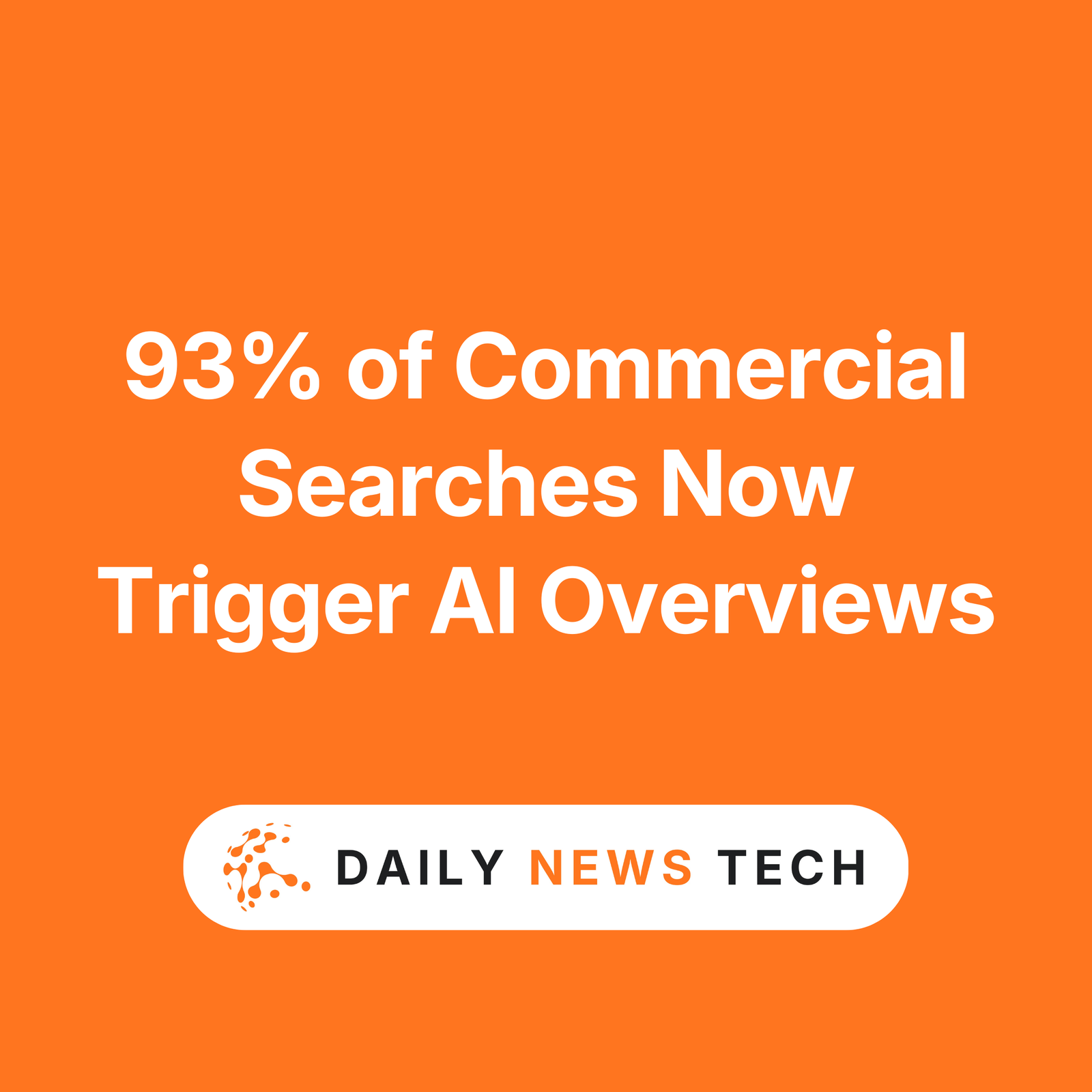
According to data shared by marketing analyst Emilia Moller, 93.05% of commercial Google searches now trigger an AI Overview, up from roughly 6% not long ago. If that figure holds up under wider scrutiny, it describes one of the fastest shifts in how search actually works that the industry has seen, and one that appears to have caught even Google off guard in terms of speed.
The part that should worry marketers isn’t just the raw percentage. It’s which searches are changing.
The Shift Is Concentrated Exactly Where the Money Is
AI Overviews aren’t appearing evenly across all search types. Commercial, high-intent queries, the searches people run while actively comparing options and deciding who to trust, are triggering AI Overviews at a dramatically higher rate than navigational searches, where someone already knows exactly what site they’re looking for.
That distinction matters more than the headline number. Navigational search was never where most of the competitive battle happened anyway. Commercial search is exactly where it happens, and it’s exactly where AI Overviews are concentrating.
Being Invisible Before the Click
The practical consequence is blunt: if a brand isn’t part of the AI-generated answer at the moment someone is comparing options, that brand may be functionally invisible before a single website is ever clicked.
Ranking on page one no longer guarantees being part of the conversation, because increasingly, there’s a summarized answer sitting above the traditional results doing the comparing for the user.
SEO Isn’t Dead. It’s Necessary but No Longer Sufficient.
None of this means traditional SEO stops mattering. Technical SEO, site authority, and strong content remain the foundation everything else is built on. What’s changed is that foundation alone no longer guarantees visibility at the moment that matters most. A useful way to think about the three layers now in play:
SEO gets a brand discovered. AEO, answer engine optimization, gets a brand recommended within an AI-generated answer. GEO, generative engine optimization, helps AI systems understand and trust a brand enough to cite it in the first place. Winning at one layer without the other two increasingly means winning only part of the visibility battle.
Three Things Worth Paying Attention To Right Now
1. Rankings Are No Longer the Whole Story
Ranking first doesn’t guarantee visibility the way it used to. Google is increasingly summarizing options directly instead of sending users through ten blue links. Brands that get cited inside that summary become part of the conversation before a click ever happens, which makes citation, not just ranking position, the metric worth tracking.
2. Commercial Intent Is Where the Shift Hits Hardest
AI Overviews are dominating exactly the queries with the most revenue riding on them: high-intent commercial searches. That concentration means the businesses with the most to gain from strong AI visibility are also the ones with the most to lose if they’re absent from it.
3. Search Evolved. It Didn’t Disappear.
Technical SEO, authority, and strong content still form the base of visibility. What’s new is the requirement to also optimize for how AI systems retrieve, understand, and choose to recommend information. Businesses adapting to that requirement early are building an advantage that appears to compound and get harder to close month over month.
What This Means Heading Into the Rest of the Year
The window for treating AI visibility as optional is closing fast, assuming the pace of this shift continues anywhere close to what’s been reported. Waiting for AI Overviews to plateau before adjusting strategy risks ceding the exact commercial queries that matter most to competitors who moved earlier.
Frequently Asked Questions
What percentage of commercial Google searches trigger an AI Overview?
According to the cited data, 93.05% of commercial Google searches now trigger an AI Overview, a sharp increase from approximately 6% previously.
What’s the difference between SEO, AEO, and GEO?
SEO focuses on getting a brand discovered through traditional search rankings. AEO, answer engine optimization, focuses on getting a brand recommended within AI-generated answers. GEO, generative engine optimization, focuses on helping AI systems understand and trust a brand enough to cite it.
Does this mean traditional SEO no longer matters?
No. Technical SEO, site authority, and strong content remain the foundation of visibility. The shift means that foundation alone is no longer sufficient to guarantee visibility in AI-generated search results.
Why are commercial searches affected more than other search types?
AI Overviews are appearing more frequently on high-intent commercial queries, where users are actively comparing options, compared to navigational searches where the user already knows which site they want.